Leading manufacturer and supplier of ready mix concrete, liquid screed and concrete pumps for the South West
  • Removes the need to have the floor sealed prior to laying
  • Gains strength quicker than anhydrite
  • Can be used in wet areas
  • Request a quote

Floor Screed

Wrightflow Liquid Floor Screed


Looking for superior flowing screed that delivers unbeatable results? Look no further than Wright Readymix and our very own Wrightflow liquid floor screed. 

Our specially manufactured liquid screed boasts exceptional durability, a smooth finish, and full compatibility with underfloor heating, making it the perfect choice for any commercial or residential project. 

You can rely on our team of professionals to manage your order seamlessly. We will not only provide and deliver screed that is specifically batched for your project, but we can also take care of the installation process, ensuring a hassle-free experience from start to finish. 

Submit our online contact form for a liquid floor screed quote or give us a call on 0117 958 2090 to find out more about our products and liquid screed pump hire.

floor screed installation

Why choose our Wrightflow liquid floor screed?


Self-levelling 

Our concrete flow screed has a liquid-like consistency and self-levelling properties, resulting in a smooth and even finish with minimal effort. 

Quick drying 

It’s much quicker to dry than other sand and cement screeds; you are usually able to walk on your new floor within 24-48 hours. 

Compatible with underfloor heating 

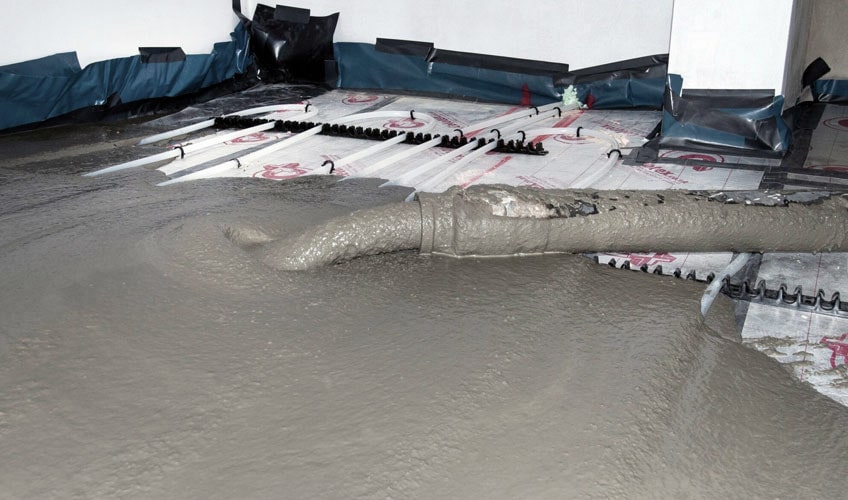
Our liquid floor screed is highly compatible with underfloor heating, as it neatly encloses pipework to eliminate air bubbles and gaps. This improves heat conductivity throughout the floor (improving the energy-efficiency of your property). 

Reduced risk of cracking or shrinkage 

Our liquid screeding contains anti-crack fibres and anti-shrink agent to improve its strength and durability. It also contains a super plasticiser for easier workability. 

Durable 

Our Wrightflow screed consists of cement, sand, limestone dust and water, helping it withstand heavy foot and vehicle traffic. 
 
To receive a quote for liquid screed delivery and installation, you can fill out our online contact form or call us directly on 0117 958 2090.

Liquid screed pump hire


When it comes to installing concrete, time is of the essence. That's why we have a range of powerful concrete pumps available for hire that can deliver liquid screed to your site quickly and efficiently, ensuring an even application and a smooth, professional finish every time. 

As seasoned liquid screed suppliers, we've tackled countless jobs over the years, giving us the versatility and expertise to take on any project, no matter how big or small. 

Our liquid screed pump hire service is the most efficient way to install liquid screed for your next commercial or DIY project. Contact us for a no-obligation quote. Alternatively, give us a call on 0117 958 2090 – our team will be happy to help.

ground line pump delivering liquid floor screed

liquid floor screed delivery over underfloor heating

When to use liquid screed flooring


When it comes to flooring options for construction and renovation projects, liquid screed is a versatile and practical choice. Unlike regular screed, liquid screed flows more smoothly and is easier to work with, making it simpler to achieve an even, level surface. 

Interior floors 

Due to its flowability, liquid screed spreads evenly across the surface of the floor. This means that it will naturally fill any gaps and crevices, including corners, without the need for manual intervention. This makes it a popular choice for interior concrete floors. 

With underfloor heating 

If you have underfloor heating, then there really is no better choice; air pockets are the enemy of heat conductivity, and using a liquid screed is the only way to eliminate these completely, ensuring that heat is distributed evenly throughout your floor. 

To discuss if liquid screed is right for your project, don’t hesitate to contact our team today on 0117 958 2090.

liquid screed flooring

Liquid Screed FAQs


Liquid screed and ready-mix concrete contain very similar components; however, liquid screed contains much finer pieces of aggregate. This gives it a smoother consistency and means it flows much more easily.

  • Liquid screed is easy to pour, and its liquid properties make it quick to dry and install.
  • It’s especially effective when combined with underfloor heating systems, as it eliminates air pockets and therefore increases conductivity. This guarantees quick and even heat supply across the floor and makes your building more thermal efficient, saving you money. 
  • Our Wrightflow liquid screed eliminates the need to seal the floor prior to laying latex, adhesive or any other cement-based product.  
  • It can also be used in wet as well as dry internal areas without degrading the screed quality. 

Liquid screed and traditional cement screed both have their advantages and disadvantages, so it's not accurate to say that one is universally better than the other.

The choice between liquid screed and cement screed depends on various factors, including the specific project requirements, the type of subfloor, and the desired finish. Our professional screeding specialists can provide more information and help you make the best choice for your project.

Yes, the advantages of flowing screed go beyond its compatibility with underfloor heating. Our Wrightflow liquid screed can be used on internal floors with or without underfloor heating.

This answer varies depending on whether the floor is bonded, unbonded, floating (commercial or domestic) or with underfloor heating. Contact a member of our team to find out the minimum thickness required for your project.

  • Remove any debris 
  • Check the sub floor for defects 
  • Install a damp proof membrane 
  • Install insulation 
  • Lay the pipework for underfloor heating (if required) 
  • Prime the floor 
  • Install an edging strip 
  • Pour the liquid screed 

For more detailed instruction, take a look at this guide to preparing your floor for liquid screed or check out our liquid screed brochure.

Yes - we require that you or an appointed representative is present at the delivery site to explain datums, undertake any adjustments to the membrane and to sign the delivery ticket as proof of delivery.

Our delivery vehicle fleet is diverse, with a uniform width of 3m (9ft) but varying lengths. For locations with restricted access, we have shorter trucks available. Additionally, our liquid screed pump hire service can ensure that even the most hard-to-reach areas are accessible.

We endeavour to meet all delivery requirements promptly - please contact our team to discuss your delivery requirements.

Between 24-48 hours is expected before you can walk on our Wrightflow screed. Cure time will depend on the thickness, and the atmosphere of the room it is being placed in, though it is typically 1 day per mm up to 40mm and 2 days per mm for the extra thickness above 40mm .  

We can give you a clearer answer once we know the details of your project, so please contact us to discuss the details of your floor screed requirements.

Like any other cement based material, liquid screed has the potential to crack. However, proper installation and curing can significantly reduce the risk of cracking

To minimise the risk of cracking, it's important to work with a professional contractor who has experience in installing liquid screed, such as ourselves. We will ensure that the mix is correct, the surface is properly prepared, and the screed is allowed to dry and cure fully. 

We do our utmost to reduce the risk of cracking further by including an anti-shrink agent, super plasticiser (to reduce the water), polypropylene fibres and limestone filler.

By using liquid screed, you can expect to achieve a more efficient and even distribution of heat across the floor, which can lead to reduced energy consumption and lower utility bills. In addition, liquid screed has a lower thermal resistance than traditional screed, which means that heat from the underfloor heating system can be transferred more quickly and effectively to the room. 

While it is difficult to give an exact figure on how much you will save on your utility bills, studies have shown that using liquid screed with underfloor heating can result in energy savings of up to 30% compared to traditional radiator heating systems.

Helpful Documents


Do you have any screed requirements? Why not contact us to find out more about the liquid screed that we supply.
We are the right people for you – let’s work together! Contact us on 0117 958 2090 today to get a quote or to find out more.

News
Troubleshooting Concrete Cracking: Common Causes & Fixes
10th December 2025

Better concrete begins with understanding how it behaves. Anyone who has poured a slab recognises the moment a fine line appears across fresh concrete. Understanding concrete cracking causes and fixes gives you the confidence to pour with fewer surprises and fewer repeat repairs. Most cracks happen when concrete dries out too fast, the base shifts, or the slab reacts to quick temperature changes before it’s strong enough.

Good curing is about stopping premature moisture loss while keeping the concrete at a steady temperature. Industry experts suggest starting curing immediately after compaction. This protects fresh concrete from drying out and helps avoid early strength loss. For consistent, ready mix with less guesswork, use our ready mix concrete.

This guide explains why cracks occur, how to spot early warning signs, and the practical steps to protect your next pour.

How to Spot the Most Common Concrete Cracking Causes on Site

Most cracks come down to three things:

  • Moisture loss
  • Ground movement
  • A mix that does not suit the job

When the surface dries faster than the concrete below, the slab shrinks unevenly. That shrinkage creates tension and shows up as fine shrinkage cracks, often within the first day. A warm, breezy day speeds this up, especially on exposed slabs.

If you’ve been outside recently, you would have noticed that the UK is experiencing warmer, drier summers more often. This makes early-age cracking more likely if curing is an afterthought. The Met Office’s analysis confirms that summer 2025 was the warmest on record for the UK, with heat now far more likely than in past decades [1]. For concrete, that increased heat means faster evaporation, greater shrinkage, and a greater risk of hairline cracking if the surface is left unprotected.

Ground conditions play a big part. A slab poured on soft or poorly compacted ground will settle into weak spots over time. That movement often shows up as wider, more defined cracks that run across driveways, patios and garden slabs. Choosing an appropriate mix of strengths helps the slab cope with its base and the loads on top. We explain different mix strengths and where they work best on our types of concrete mix and their uses page.

When you look at a cracked slab, helpful clues include:

  • Fine, shallow lines that form a random pattern across the surface.
  • Straight or diagonal cracks that follow weak spots in the base.
  • Cracks from corners or around openings where stress is concentrated.

These signs help you judge whether the issue is mainly surface shrinkage or ongoing ground movement.

Practical Ways to Prevent Concrete Cracks Before They Start

Most concrete cracking causes and fixes can be addressed by proper planning. Good prevention starts with the base, the mix and a simple curing plan that suits the weather on the day.

A stable, well-compacted sub-base gives the slab a solid seat. Soft spots or poorly compacted areas are the usual reason wider cracks appear later. Joints also help. Saw cuts or formed joints give the slab a controlled line to move along, rather than allowing random cracks through the surface.

Mix selection matters just as much. Each mix has a strength and use case, and using the wrong one can lead to extra shrinkage or premature wear. For DIY projects, match the mix to the job and load at the same time so you can pour with more confidence.

Curing is the next key step. Concrete gains strength when it retains moisture and stays at a steady temperature. The Concrete Society notes that typical curing periods are several days, and BS EN 13670 provides guidance on protecting against rapid drying and extreme temperatures [2]. On hot days, this may mean using sheeting, light spraying or curing compounds to slow evaporation. GOV.UK says heat episodes are getting more intense, longer, and more frequent [3]. This makes it more critical to plan for shade, water, and rest for both workers and concrete.

Follow These 3 Practical On-Site Checks

Before the pour:

  • Compact the base properly and plan the joint layout.
  • Choose a mix strength suited to the load and exposure.

During the pour:

  • Avoid adding excess water for workability.
  • Place and compact evenly to reduce voids and cold joints.

After the pour:

  • Start curing as soon as finishing allows.
  • Protect from direct sun, wind and heavy rain during early strength gain.

These steps will not stop concrete from moving, but they reduce the likelihood that movement will become a visible crack.

How to Fix Concrete Cracks & When to Start Again

Once a crack appears, the first step is to judge its depth, width and movement. Typically, hairline surface cracks are cosmetic. However, wider or uneven cracks can indicate movement in the base or ongoing shrinkage. Understanding what you are looking at helps you choose the right approach and avoid unnecessary work.

  • Fine hairline cracks that stay level often respond well to cleaning and sealing.
  • Wider cracks benefit from being cut, cleaned and refilled with a stronger repair mortar.
  • Cracks that keep growing usually point to issues in the base beneath the slab.
  • Frost-damaged surfaces may need sealing to prevent further freeze-thaw deterioration.
  • Hard-to-reach areas are easier to treat using our concrete pumping service.

If a crack is wide enough to catch a boot, shows vertical movement or runs in several directions, replacement is often the safer option. In those cases, speaking with a structural engineer or an experienced contractor helps you decide whether repair is worth the effort or if a new slab will yield a better long-term result.

Why Wright Ready Mix Helps Reduce Cracking Problems

A durable slab relies on the base, the mix and the curing, and the mix is the easiest part to control. Starting with consistent ready mix concrete removes much of the guesswork that leads to shrinkage, weak spots and joints that are more likely to crack.

Wright Ready Mix is the leading manufacturer and supplier of ready mix concrete, liquid screed and concrete pumps for the South West. Commercial concrete options give dependable strength and controlled water content. Meanwhile, our concrete volume calculator helps you order accurately. For supporting products such as concrete blocks, our network of local concrete plants helps projects stay stable from edge to centre. This reduces common causes of concrete cracking and the need for on-site fixes.

Call 0117 958 2090, or get in touch to plan your next pour, choose the right mix and keep cracking problems to a minimum.

External Sources

[1] Met Office, "summer 2025 was the warmest on record for the UK”: http://metoffice.gov.uk/about-us/news-and-media/media-centre/weather-and-climate-news/2025/summer-2025-is-the-warmest-on-record-for-the-uk

[2] The Concrete Society: https://www.concrete.org.uk/fingertips/curing-concrete/

[3] GOV.UK, “heat episodes are getting more intense, longer, and more frequent.”: https://www.gov.uk/government/publications/heat-mortality-monitoring-reports/heat-mortality-monitoring-report-2023

Read more
How to Level Concrete Floors for Flawless Results Every Time
03rd December 2025

Level concrete floors rely on preparation, good timing, and a mix you can trust. When those foundations are in place, the slab settles evenly and performs well under load.

That means fewer problems with:

  • Cracking
  • Floor coverings
  • Structural movement

Building Regulations Approved Document A stresses that proper ground preparation and stable bases are essential for structural integrity and preventing ground movement issues [1]. Uneven floors create issues for anything that sits on them. Tiles shift, equipment becomes unstable, and interior finishes show faults more quickly.

This guide sets out clear, concrete floor installation tips, from ground prep to levelling tools. Keep reading to learn how to DIY level concrete floors so the slab remains flat, smooth, and ready for use.

Prepare The Perfect Base for Level Concrete Floors

A level floor begins with the ground beneath it. The subfloor needs to be firm, compact, and free from anything that could move while the concrete cures. Even a few millimetres of movement can show up as dips once the slab sets. Proper ground preparation is critical for achieving flat concrete floors and avoiding costly remedial work.

  • Ensure the subfloor is well compacted, stable, and clear of loose material.
  • Plan slab thickness, falls, and expansion joints to manage drainage and movement from the start.
  • Set out strong, straight formwork to contain the pour and guide the screed.
  • Check levels with a spirit level or laser line to create reliable reference points.
  • Use our types of concrete mix guide to select a suitable ready mix with the right strength and consistency.

When the subfloor, formwork, levels, and mix choice are all in place, every stage of the pour has a clear guide to follow. This makes ready mix concrete flooring easier to place accurately.

Tools & Techniques That Make Concrete Floors Level

Once the concrete arrives, speed and control matter. Start by placing the mix evenly and using a screed board to remove excess material. This creates a flat base for later finishing. Keeping the board tight against the formwork avoids ridges and dips.

Floating refines the height and smooths the surface. A bull float or hand float pushes aggregate down and brings finer material to the surface. Slow passes give better results than fast, heavy movements. For builders working on polished concrete or interior floors, this stage sets the quality of the final finish.

For larger slabs or high-spec projects, laser levelling concrete helps you maintain consistent heights over long runs, where hand checks are slower and less reliable. They also physically highlight low or high spots before the slab cures, giving you time to correct them. For projects that need a self-levelling finish, liquid screed offers reliable depth control and strong flow characteristics.

Treat this stage as one of your core concrete floor installation tips. Even with an advanced kit on site, consistent passes and frequent checks are what turn a good mix into a level, professional slab.

Concrete Floor Finishing Tips for A Perfect Final Surface

How you pour will decide how level the concrete floor ends up. Working in sections keeps the job under control, especially on larger slabs. To keep the area manageable, screed it, then move on. This prevents one end from curing while you are still levelling the other, reducing the risk of high and low spots.

  • Pour in controlled sections so you can screed and level each area before moving on.
  • Compact the concrete to drive out air pockets and help the mix settle evenly.
  • Use simple concrete floor finishing techniques such as hand trowelling, power floating, or light brushing.
  • Keep your trowel strokes steady and consistent to avoid ridges, lines, and shadow marks.
  • Watch the surface sheen so you start final finishing when the slab has lost its wet shine but still takes a light thumbprint.

Timing is the final piece of the process. Start finishing too early, and you drag water to the surface. Leave it too late, and the slab fights every pass of the trowel. Let the concrete cure properly under controlled drying conditions to reduce the risk of cracking, keeping the floor flat and durable.

Levelling Mistakes That Ruin Concrete Floors

Even good plans can produce uneven concrete floors if a few key mistakes creep in. The first is adding extra water on-site. It makes the mix easier to push around, but it weakens the slab and encourages cracking and surface dusting. No matter if it’s a commercial or DIY project, ordering ready mix from us keeps water content under control, so the concrete arrives at the right consistency.

As we’ve already covered, ignoring the subfloor is another common issue. A soft or uneven base moves under load, leading to dips and cracks as the slab settles. Checking levels and compacting the ground takes time, but cutting corners here often leads to rework. GOV.UK Building Regulations [2] recommend adequate ground preparation and compaction to prevent structural defects in concrete slabs.

Another mistake is ignoring site conditions. Pouring in very hot, cold, or windy weather without adjusting your approach can cause:

  • Rapid drying
  • Plastic shrinkage
  • Cracking or surface crazing

Simple steps, like shading, using windbreaks, or planning pours for cooler times of day, can help you get flat concrete floors more easily.

Build Stronger, Flatter Floors with the Right Partner

For reliable, ready-mix concrete flooring, start with clear planning on site. Choose a supplier who delivers consistent quality, batch after batch. When each stage is handled carefully, the slab cures to a consistent level, carries loads as designed, and provides a base you can trust for the long term.

Wright Readymix are here to help you get there. Our ready mix concrete meets strict British Standards, with consistent, workable, and predictable deliveries. As a result, it takes away much of the guesswork from levelling. Our team can advise on the right mix for your project. No matter whether you are pouring a garage slab, a commercial floor, or a space with specific strength requirements.

Call 0117 958 2090 or contact our concrete specialists today to discuss your project and choose the right mix for level concrete floors.

External Sources

GOV.UK, “Building Regulations Approved Document A”: https://www.gov.uk/government/publications/structure-approved-document-a

GOV.UK, “Building Regulations”: https://assets.publishing.service.gov.uk/media/5a8192a0e5274a2e8ab54b5f/BR_PDF_AD_C_2013.pdf

Read more
How to Build Concrete Retaining Walls with Simple DIY Steps
26th November 2025

A good retaining wall keeps your garden steady and stops soil from creeping out of place after heavy rain. When you build concrete retaining walls, you get a stronger, longer-lasting structure that can handle pressure and weather with less hassle. GOV.UK [1] says you usually don’t need planning permission for garden walls under one metre high, or under two metres if they're not near a highway. That's why many homeowners build them to level a slope or tidy up a tricky corner.

Most problems start with shallow footings or poor drainage. Walls lean, crack, or shift because the ground and water around them were not adequately managed at the start. This guide keeps things simple. You will learn how to plan the wall, prepare a solid base, manage drainage, and pour ready mix concrete in clear, DIY-friendly steps.

Plan Your Retaining Wall Once & Build It with Confidence

Start with location. Pick a line where water can drain away, not one that sits behind the wall. Avoid building too close to sheds, fences or boundaries and check local guidance if you are unsure about height or placement.

Then decide how high the wall needs to be and what it is holding back. A short wall for a raised bed is a very different job from one keeping a whole bank in place. As height increases, the pressure behind the wall rises as well. So, keep DIY projects small, and call a pro for anything large or load-bearing. The Building Regulations [2] state that retaining walls over 1.2 metres high often need structural calculations. This is to ensure they can withstand lateral earth pressure safely.

Finally, look at the soil. Clay moves as it gets wet and dries. Sandy or loose soils can wash out if not well compacted. Knowing what you are standing on helps you choose footing depth and drainage that will keep the wall stable.

Get Your Concrete, Kit & Tools Ready Before You Dig

Ready mix concrete is the easiest way to get a strong, consistent wall. Proportions are controlled at the plant, so you can focus on the build rather than guessing ratios. If you want to see how different mixes are used for structural work, this guide is useful.

You will also need:

  • Steel bars or mesh to reinforce the wall
  • Type 1 or MOT base material for the footing
  • Clean gravel and a perforated drainpipe for water runoff
  • Landscape fabric to stop soil from working its way through

Keep tools simple and practical. A spade, tamper, level, wheelbarrow, formwork boards and basic PPE will handle most small walls. If you are new to this kind of project, our DIY concrete page has straightforward advice for first-timers.

Simple DIY Steps to Build a Concrete Retaining Wall

Step 1: Excavate a Level Base Trench that Will Not Move

Mark out the line of the wall and dig a trench wide enough for the footing and formwork. The trench should be deep enough to sit below the topsoil and give the wall a firm seat. Compact the bottom of the trench and add a layer of Type 1 base, keeping it level from end to end.

Check your levels as you go. Take your time here, and the rest of the build will be easier.

Step 2: Add Drainage & Gravel so Water Has Somewhere to Go

Lay landscape fabric along the back of the trench and place a perforated drain pipe at the lowest point. Cover it with clean gravel so water has a clear route away from the wall. This reduces the pressure that can build up behind concrete. Proper drainage is essential because saturated soil increases pressure on retaining structures. This follows principles outlined in the GOV.UK guidance on managing surface water [3].

Think of the pipe and gravel as the safety valve for your wall.

Step 3: Set Your Formwork & Steel to Shape a Strong Wall

Fix timber formwork along the trench to define the wall's shape and height. Brace it so it will not move once the concrete goes in. Place steel bars or mesh inside the form, raised slightly on small spacers so it sits within the wall, not on the soil.

Check that the steel runs where the greatest pressure will be, near the back of the wall.

Step 4: Pour Ready Mix Concrete for A Clean, Solid Wall

Book your concrete delivery for a time when the forms and reinforcement are ready. Pour the ready mix in stages and use a shovel or rod to work it into corners and around the steel.

Tap the formwork to bring air bubbles to the surface and level the top with a straight edge so the wall has a clean finish.

Step 5: Let the Wall Cure, Then Backfill & Finish the Ground

Let the concrete cure according to the guidance for your chosen mix. Keep it shaded from intense sun and protected from heavy rain in the early stages. When it is firm, remove the formwork and check for any apparent defects. Backfill with gravel behind the wall and compact soil above in layers so the ground supports rather than strains the concrete.

Give the wall time to gain strength before loading it with heavy features or deep beds.

Keep Your Wall Steady, Keep Your Garden Sorted

A well-built concrete retaining wall holds back soil, levels uneven ground, and stays firm through winter weather. Plan the line, footing and height carefully, and your retaining wall becomes a stable framework for terraces, lawns and beds that will work with your garden for seasons. Using ready mix concrete also means you can pour the wall in one organised run, rather than stopping to mix by hand, and a simple volume calculator helps you size the order so you avoid both waste and shortfalls.

Wright Readymix delivers ready mix concrete across the South West, with mixes suited to small DIY jobs and larger landscaping projects. Our team can guide you on the right strength, help you estimate volumes using our concrete volume calculator, and arrange delivery that works around your schedule.

Call 0117 958 2090, or get in touch to talk through your retaining wall project and book the concrete you need.

External Sources

[1] https://www.gov.uk/planning-permission-england-wales

[2] https://www.gov.uk/building-regulations-approval

[3] https://www.gov.uk/guidance/flood-risk-and-coastal-change

Read more
Concrete vs Steel: Which Material Is Better to Build With?
23rd October 2025

Every construction project begins with one key question: which material delivers the best results? Across the South West and South Wales, that choice often comes down to concrete vs steel. Both have played a key role in the UK’s built environment for decades. Each offers unique strengths that influence cost, performance, and sustainability.

Concrete provides high compressive strength and strong thermal efficiency, creating stable, energy-efficient buildings. Steel provides strong tensile strength and precise design. This makes it perfect for long-span and high-rise structures. The Institution of Civil Engineers (ICE) states that much of today’s infrastructure relies on reinforced concrete. This combination of both materials balances flexibility and durability. However, concrete’s affordability, local sourcing, and long lifespan make it the most practical option for most UK builds.

We offer ready-mix concrete that meets British Standards (BS 8500-2) and deliver it quickly throughout the region.

How Do Concrete & Steel Compare in Construction?

ICE identifies strength and behaviour under load as the main difference between concrete and steel. Concrete excels when compressed, so it’s perfect for footings, walls, and load-bearing slabs. Steel excels in tension, resisting bending or stretching. This is an excellent advantage for high-rise buildings and long-span structures such as bridges.

When used together in reinforced concrete, the materials complement one another. The steel absorbs tensile forces, while the concrete distributes compressive loads. This creates a strong and balanced structure that works well for many commercial and home projects in the UK.

Concrete provides substantial thermal performance benefits. It helps keep indoor temperatures stable and lowers heating demand. The Building Research Establishment (BRE) explains that concrete’s thermal mass can help lessen peak energy loads. It does this by absorbing heat and slowly releasing it. This process boosts comfort and efficiency in buildings. Steel can achieve similar results but often requires added insulation to match concrete’s performance.

To enhance supply and speed up delivery, we operate various regional plants. These plants are set up for fast batching and local delivery, and you can learn more via our concrete plants page.

What Costs More to Build With Concrete or Steel?

For most UK projects, concrete continues to offer greater cost stability than steel. Data from the House of Commons shows that steel prices are more volatile. Its price is influenced by energy costs and global supply chains, hence the need for the government’s steel strategy. Concrete, on the other hand, is primarily produced and sourced locally. This helps maintain predictable pricing and availability.

Steel structures help shorten construction time through prefabrication. However, the increased costs of fabrication and transport can eat into those savings. Concrete is affordable, available, and easy to place. This makes it the top choice for home and business projects in the South West.

Key advantages of concrete for cost control:

  • Concrete is sourced locally, reducing transport costs and environmental impact.
  • Each mix is precision-batched to minimise waste and improve efficiency.
  • LGW's regional plants support reliable delivery schedules.

As part of The LGW Group, we offer consistent pricing and dependable supply across the South West. Our team also provides concrete pumping services. These help streamline on-site delivery and reduce labour costs by enabling faster, cleaner pours.

Why Concrete Leads in Sustainability & Longevity

The key difference in sustainability between concrete and steel lies in how they perform throughout their lifecycles. Steel is fully recyclable, but its production is energy-intensive, requiring temperatures of over 1,500°C. Concrete can use recycled aggregates and low-carbon cement substitutes. This helps reduce embodied carbon while still maintaining strong performance.

The UK Green Building Council (UKGBC) says the construction sector needs to cut whole-life emissions. This can be achieved by improving material efficiency and reducing transport miles. We help achieve this goal by using local batching and delivery. This reduces haulage distances and lowers fuel use across the South West.

Sustainable advantages of concrete include:

  • Using locally sourced materials reduces transport emissions.
  • High thermal efficiency reduces operational energy use.
  • Long service life with minimal maintenance.

Concrete’s durability also supports sustainability by extending the lifespan of structures. The Building Research Establishment (BRE) says reinforced concrete can last over 100 years. That is, if it is mixed and properly looked after. In coastal or humid areas, steel parts usually need protective coatings or galvanising to avoid corrosion. Maintenance concrete often skips this step.

This long-term resilience plays a key role in the UK’s Net Zero Strategy. It focuses on using low-maintenance, low-emission building materials for sustainable construction.

Top 3 Reasons Concrete Is Still the Core of Modern Construction

Steel is key to structural engineering, yet concrete remains the foundation of most construction in the UK. Its performance, versatility, and local availability make it a reliable choice for all types of projects. This includes everything from small home extensions to large commercial developments.

1. Versatility for Every Project

Concrete can be poured, shaped, and finished to meet almost any specification. It supports decorative architectural work, large-scale structural elements, and even polished interiors. We supply liquid screed for smooth and efficient flooring. It meets current performance standards.

2. Long-Term Durability

Concrete resists fire, weather, and corrosion, maintaining its structural integrity for decades. High-density concrete is a preferred material for safety and longevity in UK building standards. For domestic use, we provide tailored mixes for driveways and shed bases to ensure reliable strength and finish.

3. Cost Stability & Efficiency

Concrete remains a stable option for costs. This is thanks to its local sourcing and efficient production methods. We provide accurate batching and flexible delivery from various regional plants. This helps contractors reduce waste and stay on track. Materials like bulk bag aggregates and gravels enhance on-site efficiency and aid in resource planning.

Concrete is versatile, resilient, and affordable. These qualities make it a top choice for builders, developers, and homeowners in the South West. This approach supports lasting value and sustainable growth in the region.

Your Project Deserves Concrete Confidence

In the concrete vs steel debate, both materials remain vital to construction. However, concrete offers the best balance of strength, cost stability, and sustainability. Its flexibility and local sourcing make it a reliable choice for both small foundations and large commercial builds.

Choosing Wright Readymix means working with a trusted regional supplier backed by The LGW Group. Every batch meets British Standards (BS 8500-2) and is delivered with precision to projects across the South West. Explore our testimonials and news pages for feedback and expert guides like the complete guide to concrete footings.

Call 0117 958 2090, or contact our concrete specialists today to ensure your mix meets specification, schedule, and budget.

Read more