


.jpg?time=1676027350857)


If your deck has leant, tilted, or cracked open, you’re likely scratching your head wondering why. The first thing people blame is the timber, but often it’s what’s underneath that’s responsible. Pouring concrete deck footings properly, right from the ground up, is the part of the job that decides whether your deck stays level for years or starts moving within a couple of seasons.
This guide takes you through the whole process, from checking the ground to knowing when your deck foundations are ready to take weight, so nothing gets missed before the first post goes in.
Getting the Ground Ready
Before any concrete goes near a hole, the ground itself needs proper ground preparation. Clear away the topsoil, turf, and any other organic material under each footing position, because that material will rot, shrink, and settle over time, taking your deck with it. This is also the point to look closely at what you're digging into. If you hit clay that's holding water, or ground that feels spongy underfoot, you may need to dig deeper or pack in a layer of compacted hardcore before going any further.
When figuring out how to pour concrete deck footings, it’s important to make sure it’s on ground that’s been properly checked. Failure to do so is asking for trouble further down the line. A bit of extra digging now is far cheaper than jacking up a sunken deck two summers later, and it sets you up for the next decision, which is how deep those footings need to be.
How Deep Should Deck Footings Be?
There’s no single answer because the right footing depth depends on your soil and what the deck is carrying. As a general rule for most UK gardens, deck footings should be at least 450mm deep, and often 450–600mm, to sit below the frost line and prevent frost heave. Heavier or elevated decks, sites on shrinkable clay, or positions near trees, boundaries, or slopes may require greater depths and should be checked against Building Regulations and site conditions.
It's also worth checking against Building Regulations Part A if your deck is supporting a roof or an attached structure, rather than a simple ground-level platform [1]. Pouring concrete deck footings that are too shallow is one of the most common reasons a deck starts moving within a year or two, so when in doubt, go deeper rather than shallower. It costs a little more concrete now and saves a lot of grief later.
Choosing Your Formwork: Cardboard Tube Forms
Once the holes are dug to the right depth, you need something to hold the concrete in shape while it takes on strength, which is what curing time means in practice. For most domestic deck jobs, that means a tube former. Cardboard tube forms are cheap, easy to cut with a handsaw, and give a clean, round footing that backfills easily once it's set.
Knowing how to use cardboard tube forms for footings comes down to a few simple habits:
- Cut each tube slightly longer than the hole depth
- Sit it plumb and level before backfilling
- Pack soil firmly around the outside so it can't lean
- Check it's still square just before pouring
Pouring concrete deck footings into a tube that isn't square from the start means fighting that lean the whole way through, so it's worth taking the extra few minutes to get this right before the first barrow load goes in.
Correctly Executing Rebar Placement
Concrete is strong under compression but weak under tension, which is exactly the kind of stress a footing experiences as posts flex and load shifts with the seasons. That's why rebar placement matters. A single length of reinforcing bar, set vertically through the centre of each footing and held with roughly 50mm of concrete cover on all sides, gives the footing tensile strength that plain concrete can't provide on its own.
Skip this step on a small garden step and you might get away with it. Skip it on anything load-bearing, and you're building in a weakness that won't show itself until the crack appears, usually after a wet winter or two. Pouring concrete deck footings without this reinforcement in place is one of the shortcuts that costs the most further down the line, because there's no way to fix it once the concrete's gone off.
Working Out How Much Concrete You Need
With your holes dug and your tubes in place, it's time to work out volume. A concrete calculator for deck footings will give you a rough figure based on hole diameter and depth, and it's always worth rounding up rather than down, since running short mid-pour means a delay while more concrete arrives and the first batch starts to set.
For anyone working through how to pour concrete deck footings across a multi-post deck, batching the pour footing by footing, rather than trying to mix and place everything at once, usually gives a more consistent, better-finished result across the whole frame. It also means each footing gets your full attention while it matters most, rather than being rushed because three others are waiting. Once you know roughly how much you need, the next job is getting it into the ground and set correctly.
Pouring, Post Anchors and Curing Time
The best approach is to pour the concrete in stages, tamping as you go to knock out air pockets that would otherwise weaken the footing. Make sure to screed the top level with the surrounding ground, or slightly above it, so water doesn't pool against the post base later. Knowing when to install post anchors in wet concrete matters just as much as the pour: push each anchor into the mix while it's still workable, check it's plumb in both directions, then leave it undisturbed.
From there, the concrete needs proper curing time before it takes real load, typically around seven days before light work and closer to twenty-eight days for full strength.
Most footing failures trace back to the same handful of shortcuts:
- Skipping ground preparation and pouring onto loose or organic soil
- Getting footing depth wrong for the local soil and frost conditions
- Leaving out rebar placement on anything beyond the smallest structure
- Pouring concrete deck footings without proper curing before loading them
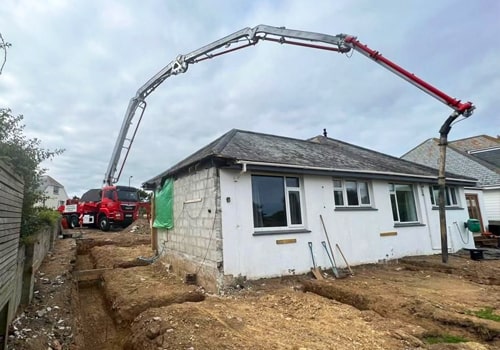
This is the stage where we're often called in, delivering ready mix concrete that's on site exactly when your footings need it.
Get Your Deck Footings Right from the Start
Getting your deck foundations right isn't complicated, but it does need doing in the right order, from the ground up to proper curing. So, how deep should deck footings be for your site? If you want further guidance or would like to request concrete pump hire, that’s exactly what we’re here for.
Call us on 0117 958 2090, or send a message through our contact form, and our team at Wright Readymix will get you sorted.
External Sources
[1] GOV.UK, ‘Structure: Approved Document A’: https://www.gov.uk/government/publications/structure-approved-document-a